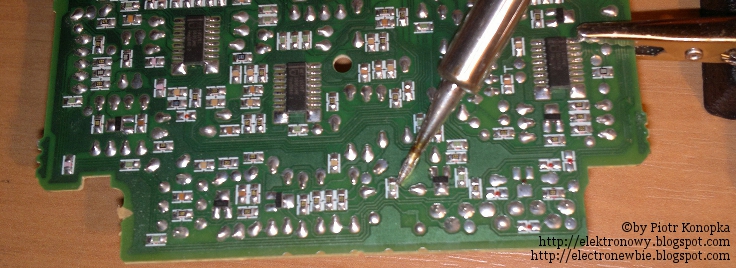
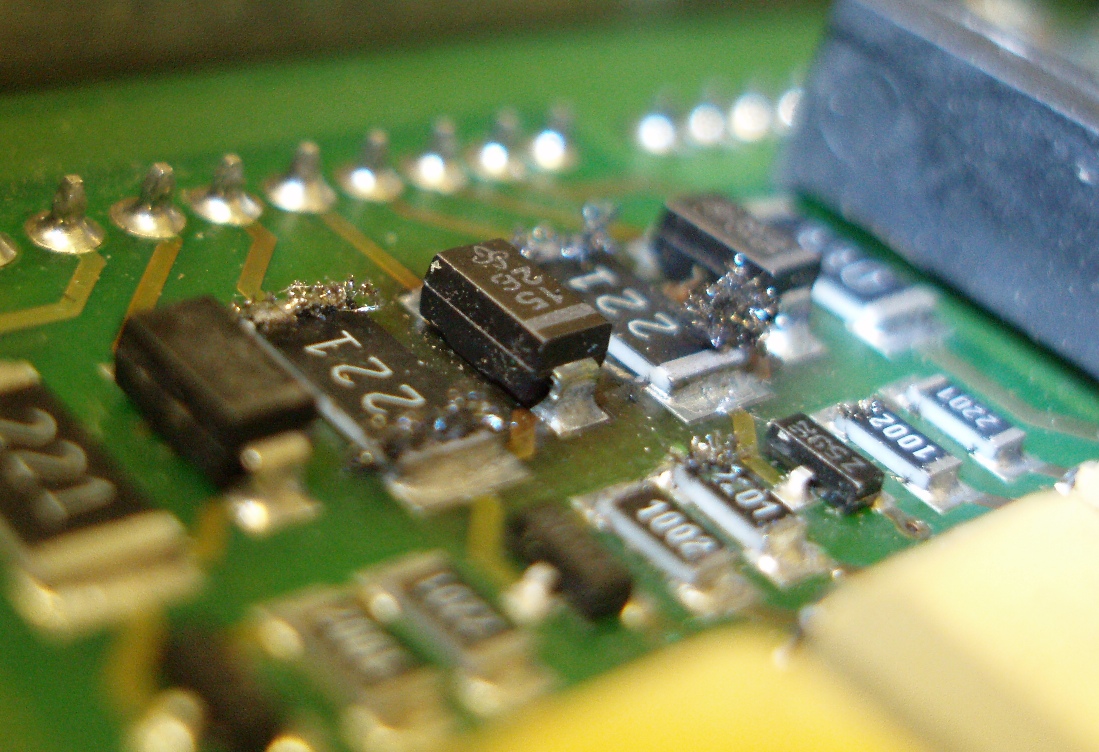
Game of Thrones has became very popular lately and in the series there are two books (parts of one tome: Storm of Swords) titled "Steel and snow" and "Blood and gold", thus I decided to name this post "Rosin and tin" aiming with this cheap move to gain the favor of fans of this series (which I myself like a lot) ;>.
That, and the fact that rosin is the most often used flux, while tin is the main component of all the soldering alloys which are being used in electronics - so it's hard to not place them in title ;)
To the topic then.
2. Soldering alloys (solder, tin, soldering filler)
 |
| Spools of solder - alloy of tin (60%) and lead (40%) - one of most popular alloys in electronics. Both solders contain flux core. Both weigh 0,1kg. On the left a spool of 0,7mm diameter (~21 gauge) wire - very good for soldering electronics, on the right 3mm diameter (~9 gauge) wire - too thick for use in electronics. |
When you already have a soldering iron, you'll need soldering filler that you'll be using to solder components with.
The most common soldering alloy in amateur electronics is tin (Sn) with lead (Pb) alloy in proportion of 63% Sn 37% Pb.
This is an eutectic alloy - in normal language meaning that in a given temperature (for this alloy it's 183 Celsius or 361 Fahrenheit degrees) the alloy changes its state from solid to liquid while melting, and more importantly freezing from liquid to solid without going through a plastic phase.
It is important, as with solders not having this trait, the plastic phase - when solder for a moment is not completely liquid anymore, but it isn't completely solid yet, being soft like clay or putty - gives much bigger possibility of soldering errors caused by moving the component in not fully solid solder.
Other commonly used solder is an alloy of 60% Sn 40% Pb with similar traits to the above.
There also are many similar alloys with 1-3% additions of silver (Ag) and bismuth (Bi).
1st July 2006. an European Union directive came to life under abbreviation RoHS (Restriction of Hazardous Substances). And similar laws in other countries outside EU so it might concern you too (blah, blah, law, law, yada yada - I know ;).
Their aim is among others reducing use (and by this escaping to environment) of such substances as lead, which is harmful and accumulates in organism (so don't eat solder, don't hold it in your mouth, wash hands, don't rub your eyes, don't eat in place where you do the soldering and keep solder away from children; I already wrote more about dangers in electronics in an earlier
post).
Because of this in industrial uses in many countries it is prohibited to use solders containing lead, however its use for amateur purposes is still allowed (at least under RoHS - check your country laws to make sure).
Means that unless you are introducing your products into market by selling them, it is ok - if you plan on selling them, read those regulations to check if exceptions from them apply to you, or you'll need to use lead-free solders.
Lead-free solders are such as those below (tin is majority of the alloy, the % values are for other elements and tin completes all the left volume up to 100%; in parentheses temperatures in Celsius/Fahrenheit degrees):
Sn Ag 3,5% (221/430)
Sn Ag 2,0% (221-226/430-439)
Sn Cu 0,7% (227/440)
Sn Ag 3,5% Bi 3,0% (206-213/403-415)
Sn Bi 7,5% Ag 2,0% (207-212/404-414)
Sn Ag 3,8% Cu 0,7% (217/423)
Sn Ag 2,6% Cu 0,8% Sb 0,5% (216-222/421-432)
As can be easily noticed, the melting temperatures are higher than 183 Celsius (361 Fahrenheit) degrees of the most common tin-lead alloy.
That results in higher risk of damage to the electronic components (which isn't a huge problem with good soldering technique, maybe besides the most sensitive parts and/or equipment that is supposed to last really long and/or in a hard environment) and faster wear of the soldering tools parts (mainly the heater) and their tips.
As you can see next to some alloys there is a range of temperatures, that means that they go through a plastic phase, which as I mentioned increases risk of soldering errors.
In addition a bane of the lead-free soldering are so called tin whiskers - a problem because of which lead was introduced to soldering alloys over half century ago in the first place. With longtime usage of electronics in some soldered joints made with lead-free solder tiny needle-like structures form, which can short the circuit and in result cause a failure or destruction of the device.
 |
| Tin whiskers spontaneously forming on lead-free solder. Source: Wikipedia |
Another problem is that most of the lead-free soldered joints don't shine nicely unlike lead alloy ones. As much as aesthetic aspect is not that important, it is very important that it influences the difficulty of checking the soldered joint for errors - with leaded solder, when it doesn't shine nicely, it is almost certain that it should be corrected because it either was not heated high enough or was overheated (and all flux was burnt). Lead-free solder is always matte so there is no hint like that.
Generally speaking, besides ecologic aspect, lead-free solder sucks ;P
Of course electronics companies are making efforts to discover a lead-free solder that would have as good traits as the leaded one - none did attain that goal yet though.
Even if you really like 'green' technology, I'd recommend you to start your adventure with electronics from the leaded solder - at least until you learn to solder correctly each time.
Because as I mentioned it's much easier to notice your soldering errors with the leaded solder than with the lead-free ones.
Later you can carry on to use lead-free ones if you will want to.
Forms of solder.
Most commonly known and recognized is the solder in shape of a wire.
We are mainly interested in
0,6-1mm diameters (~18-23 gauge). I personally use mainly
0,7mm (~21 gauge). It is good for through-hole components (with too thin wire you'd need to feed too big length to achieve good joint, because you'll overheat the solder and components) as well as for SMD (too thick won't let you tin tiny pads - places for soldering electronic components to them - on a circuit board and components' leads).
There are components for which smaller diameter (so higher gauge) solder wire is better - modern integrated circuits with very thin legs, but until now I didn't have need to solder them and it certainly isn't a topic for beginners, more like a specialized use.
Solder spools are usually sold in set lengths (1,5m; 3m etc.) or by a set weight (0,1kg; 0,2kg; 0,5kg) - a spool weighing 0,1kg (as in picture) is really enough for the start, later during work you'll learn how much of it you're using and how much you actually need to buy.
You can also buy solder in a vial - the wire is coiled and packed into a cylindrical container - it's supposed to be quite comfortable in use, I haven't checked myself as it costs a bit more than regular wire spool, which seems good enough for me.
You should check if given solder contains a flux (usually rosin) core (or cores). It should be written on its label.
Tin without a flux (especially those thick triangle cross-section shaped rods of solder for soldering pipes and gutters) practically
is useless for electronics. Why? About fluxes in next point below. Anyway, soldering with solder without flux will be uncomfortable, tedious and you'll end up using additional flux anyway.
There are various
solder pastes (also called solder creams) - they are made mainly from ground solder and flux - they're good for soldering surface mount components, similarly to BGA balls which are applied through special sieves fitted for specific integrated circuits' pads and lands on the circuit boards for them.
It is comfortable and may speed up your work, but isn't indispensable - tinning such small pads is also possible and quite comfortable with a soldering iron with 'miniwave' (or 'microwave' - don't mistake with microwaves as electromagnetic waves, it has nothing in common with them, and anyway it's easier to find them in internet under 'miniwave' name, because otherwise there is lots of pesky microwave ovens in the results ;P ). More about soldering bits in further posts.
In general regular solder wire with rosin core and additional flux will let you do almost everything.
A spool of 0,1kg solder wire 0,7mm costs around 30-35PLN (~8EUR/10USD), but it should be enough for quite long if you don't do mass production ;)
I personally also own a spool of 0,1kg of 3mm (9 gauge) solder, but I don't use it for strictly electronic purposes - it can be useful for tinning wires and quick tinning soldering iron tips.
3. Flux
 |
Fluxes I use: 1. Rosin - almost new, used just once, 2. Rosin dissolved in alcohol in a syringe with a needle for comfortable application to soldered/desoldered places, 3. Aspirin for use in crisis situations with very dirty components giving me a headache, 4. Brushes for quickly smearing the rosin solution over larger surfaces and for washing impurities off with alcohol. |
Fluxes are substances which help in soldering by chemically cleaning (reducing - deoxidizing) connected metals thanks to general reaction which can be shown as:
metal oxide + acid ==> metal + salt (which usually doesn't harm us) + water (which evaporates)
Flux is the third and last piece, next to solder and soldering iron, indispensable in soldering. It's indispensable because on the surface of components being soldered there is always thinner or thicker layer of oxidized metals they're made from - especially easily forming on copper surfaces from which copper circuits on circuit boards and various cables and wires are made.
Fluxes usually fulfill three functions:
- they remove oxides and other impurities, like fat residue from touching, or other impurities from storing components for longer time,
- they prevent oxides from forming during soldering (cutting physically the access of air),
- they make solder liquefying easier and make solder flow better - reducing its surface tension, thanks to which solder can much more easily flow in between surfaces being connected, drew in by the capillary action into small spaces, forming much better connection between soldered components wetting them well and creating a strong connection by diffusion (I wrote about that in
post 2.0 ;).
While soldering of new components onto a new circuit board with fresh tin with flux core may be easy, you'll instantly learn to prize owning a stock of good flux when you start using older components e.g. from desoldering from old, not needed boards, coated with dust, dirt, greases, oxides or damaged by acid from spilled electrolytic capacitor and so on ;)
That's why I recommend starting not from soldering, but from desoldering - that teaches quite quickly a healthy habit called 'never too much rosin'. ;)
Rosin (aka colophony).
Unarguably most well known, most popular and most easily available flux, and if you for example play a violin or dance in ballet it could have other uses too ;P
Rosin is made from resin - mainly from pine. It is made after distilling turpentine from it. Rosin is a brittle yellowish-brown substance resembling a bit an amber (it's resin after all too). It easily melts in the temperatures used in soldering. It's quite flammable, so if it gets overheated on components/board/soldering tip, it'll burn leaving brownish-black residue.One uses it by quickly dipping the iron's tip into the rosin can (it usually is sold in metal cans similar to one shoe paste may be sold in), and next moving quickly a bit of molten rosin to the place we want to coat. Speed is quite important, because we don't want to burn it.
Rosin is one of 'no-clean' type fluxes, which means that it isn't necessary to wash the excess off from the soldered components and the board, thanks to the fact that abietic acid - its active substance - after cooling down stays locked inside rosin's structure, thanks to which it doesn't corrode the components and printed circuit.
Unlike many other fluxes rosin (and other 'no-clean' fluxes) create a protective layer which prevents corrosion of unprotected metal parts.
One of uses of rosin is dissolving it in 95% alcohol and 'painting' freshly etched circuit boards with it, especially if a protective layer of special paint (so called soldermask), which is supposed to protect the copper circuits, isn't made. Thanks to this procedure not only copper circuits are protected from atmospheric and humidity influences which would cause immediate oxidization, but also it is much easier to solder on such board thanks to the traits of rosin.
Rosin is easily soluble in organic solvents e.g. acetone, alcohols (among the ethyl alcohol), petrol and many others. It doesn't dissolve in water.
Thanks to that by putting solid rosin into a jar and pouring inside alcohol (I recommend using 95% pure ethyl alcohol thanks to which one can get a solution without any additional impurities, but as it costs around 15-18PLN (~4EUR/5USD) per 200ml some would rather use colorless stained alcohol which is a bit less pure, but costs around 6-7PLN (1,5EUR/2USD) per 500ml). It's worth to make as saturated solution as possible, after some amount (I won't give exact proportions as it depends on kind of used alcohol and rosin) adding just a bit of alcohol from time to time until the rosin gets dissolved completely, and no more - thanks to this you'll have more rosin in the same volume, so we will have to apply less afterwards. In addition to that a syringe with a needle is useful for precise application (you can buy it in a pharmacy for a few cents) and a brush for coating larger surfaces.
Such application of rosin is much more comfortable than moving solid rosin with iron tip - especially for tiny components.
Warning: you shouldn't use salicylic alcohol for that - the result of leaving it on the board will be forming of salicylic acid, which can digest the circuits and components, while normal ('edible') pure ethyl alcohol evaporates completely very quickly in room temperature, leaving no residue - only residue left will be whitish-yellow rosin residue.
Yes salicylic acid, popular aspirin is a flux too, very strong one, sometimes useful in extreme cases - you put the components to be soldered on a pill and heat them with soldering iron. Don't lean over it, don't breath in, the fumes are highly caustic.
Warning! As I mentioned in the
post regarding safety, while molten rosin may smell quite nice similar to resin, you should not inhale it, the products of burning it (and exactly that are the fumes rising from it), contain cyclic carbon compounds which are carcinogenic.
You should always solder in a well ventilated room, if you can, also having a fan - even a simplest fan placed by your side, so that it'll push the fumes to the side, away from you.
The solder itself doesn't evaporate in such temperatures - if you can see a smoke rising from heated solder - you're burning the flux from wire core. The tin itself (or more like the lead in the alloy) isn't harmful until you eat it, put it in your eye, or any other place where mucous membranes are. So don't hold it in your mouth.
In addition to that rosin while heated may sizzle and splash around.
So wear protective goggles during work.
In case of burning the rosin on a board/components being soldered it is
necessary to wash the burnt residue, because it consists of carbon compounds, which conduct electricity, so they can short the circuit and cause a failure or even destruction of the circuit board and electronic components.
Wash it off with one of solvents mentioned above (again -
not salicylic alcohol!).
I use 95% pure ethyl alcohol.
Sticky hands, tabletops and other tools (yes, rosin just like normal resin is sticky, especially if applied in a thin layer, just like after dissolving in alcohol) you can clean off with same alcohol or petrol (which has the the downside of leaving a smell which not everyone may like, unlike the alcohol which will evaporate very quickly without leaving a smell).
Washing hands with alcohol/petrol too often dries out the skin, so I don't recommend it, and if it would happen it's good to use some anointing (fat based) hand cream (hey, that we work with electrics/electronics, doesn't mean we have to look like untidy, dirty rednecks - no offense to clean and tidy people living in rural areas ;).
The cost of rosin is around 7PLN (1,5EUR/2USD) for 35g per container which will last quite long. The cost of alcohol I already mentioned above, and the 200ml should last a longer while too.
Other fluxes.
There are many various fluxes, among them more aggressive ones used in harder cases and for soldering more difficult materials than our components - usually those are various acids, the more difficult soldering, the higher the temperatures and the more resistant metals - the more aggressive, caustic the fluxes.
Some tin alloys for lead-free soldering also require more aggressive fluxes.
Next reason why lead-free alloys are bad ;)
Many other fluxes require washing them off with proper solvent. Unless they are, like rosin of the 'no-clean' type, which will always be mentioned on the label as it is important for the producer - he can sell 'no-clean' fluxes for higher price.
Various
flux pastes are comfortable in applying onto a board, there are various
liquid and spray fluxes and such - if you'll need, you'll certainly find something comfortable for the use you plan on.
In normal electronic uses with leaded soldering they're not required. If you have a problem with using rosin and its solution - go ahead and search for more precise info in internet - usually it's quite easy to find. I don't have much experience with them, as until now rosin and alcohol were good enough for me ;)
It's worth to repeat it -
there's never too much flux, usually adding flux solves a large part of problems one can have in the beginning with soldering.
That would be all concerning solders and fluxes.
In the next part I'm writing about additional items for soldering iron which aren't as indispensable, but can certainly make your life easier, speed the work up and make your tools' life longer, and then in the next post will move on to the soldering bits/tips for irons, so I invite you to the further reading, and as always in case of any questions or comments - I invite to writing comments ;)
Next part: 2.3 Soldering - Basics - Accessories
Previous part: 2.1. Soldering - Basics - Which soldering tool?
Beginning: 1. Safety rules and hazards in electrics and electronics